Saturday, April 16, 2016

Don't Be too Hard on Mrs. Bennet


When I first read Pride and Prejudice by Jane Austen, I was closer to Jane Bennet's age and did think Mrs. Bennet a somewhat ridiculous creature. Now close to Mrs, Bennet's age, I understand her. Women of our age go through drastic changes physically, mentally and emotionally. For instance the past few months, I have been experiencing some severe symptoms of perimenopause: nightly hot flushes, adrenaline surges, full-blown panic attacks (several per night and day,) muscle aches and stiff joints, abdominal pains, bloating, tender breasts, and more.

Two nights ago, stretched out upon my bed in the wee hours of the morning, unable to sleep, the attacks were horribly bad-- heart palpitations, flutters, muscle spasms, anxiety, and uncontrollable shaking-- aware of every little pain, twitch and tingle. After much prayer, reading of the Psalms and listening to relaxing music, the Lord blessed me with a thought to put my troubles in perspective and give me at least some mental relief. I suddenly recalled the scene with Mrs. Bennet after Lydia ran away with Mr. Wickham where she lay in her bed, crying and complaining to Jane, Elizabeth, Mary and Kitty of her ailments and the distress caused by the actions of her "baby" Lydia, which she blamed upon the neglect of the Forsters.
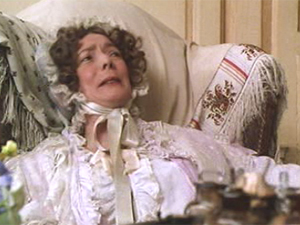


In the midst of my self-pity, I had to laugh!

Poor Mrs. Bennet was going through the change of life! She wasn't making up her complaints. They were very real. Throughout the pages of Pride and Prejudice her anxious nature and her obsessive behaviors are documented. Though Mr. Bennet and her daughter Elizabeth considered her silly and shallow, her other daughters were respectful of her, I would dare say they understood her. After all, her concern was for them, with a bit of self-preservation mixed in with her motives

In that era and society, to become poor was a terrifying prospect, but to be a poor widow woman was the worst of nightmares! In her mind, she had made a good match for herself, marrying a gentleman with an estate above modest, but fate and the laws of the land that entailed the estate to the closest male heir robbed her and her daughters of their security, the security of a good dowry for the girls and the assurance of comfort in her golden years.  


Anything that interfered with her objectives or endangered her plans was extremely vexing. She would be very anxious indeed. And though I doubt she had a full realization of the consequences that Lydia's actions could have caused, she was aware enough to know that everything that she had hoped for, every security that she had placed in advantageous marriages for her children, was jeopardized. Had not Mr. Darcy coerced Mr. Wickham to marry Lydia, the family would have been ostracized from all "good" society, thus dooming her and the girls to a life so below their current means and status that she could foresee only misery and doom. Her fears were well-founded.

Such stress could easily throw her into a series of sleepless nights and fitful days, hot flashes and panic attacks. All of which are very real physical, painful and frightening reactions to bear that can go on for days, weeks, months--even years! Jane had compassion for her mother; Mary, patience, and Kitty, patient support. Yet Mr. Bennet could not understand--he was a man, after all. And Elizabeth could not understand, being young and independent, favoring her father, until she--too--was faced with the reality of an impoverished life and saw the misery that her mother suffered as a result of the anxiety.

How many of today's women around her time of life could cope with the disappointment of a wayward child; the loss of her dreams and hopes for a secure future and the futures of her other children; as well as anxiety attacks, pains, spasms and palpitations without Xanax, Valium, hormone replacement therapy, and psychiatric or psychological therapy? Without these, Mrs. Bennet had to cope. Give the woman a break!


Lori Vidak
4-16-16

Saturday, March 7, 2015

A Cogitation from God

   Woke early this Saturday morning with a headache. Unable to go back to sleep, the quiet encouraged pondering. God is triune in Nature--Father, Son and Holy Spirit. The Trinity is God. The Father is God. Yeshua is God. The Holy Spirit is God. Three persons are one God. I know this to be true, even though this concept is beyond my human mind to totally grasp.
   Then, as though to help me better grasp the nature of God, examples found in nature and my culture popped into my mind. A pride of lions is one. Each lion is an individual member of the pride. There's the Alpha male and Alpha female then the rest of the pride. They all work together as the pride. The same with a wolf pack.
   In marriage, a man and woman become one flesh. Two individuals become one in name, finances, and the purpose of procreation. The more unified the couple, the stronger the marriage. When children come along, a new oneness in function is added called family.
  In team sports, you have the team. You cannot have a team unless each individual member of the team does his part for and with the team.
   Our earth is part of  a solar system. What is the solar system? Our sun, the planets, their moons some asteroids and a comet or two. And then there's a galaxy. What is a galaxy? A unit of solar systems and whatnots, even black holes.
   I think of a tree. A tree is the leaves, the roots, the trunk and the branches.
   Humans are mind. body and spirit. The physical body is made up of billions of different cells functioning as one. The mind is billions of thoughts, memories, dreams and problem solving functions. The spirit is what makes me, me. It is the eternal part of me. The part of me that functions beyond my five senses. The spirit is what makes living things not simply computers and robots.

   These are simplistic examples, and I could go on and on with other examples as new ones present themselves. However, these serve the purpose, at least for me, to show that God is Father, Son and Holy Spirit. God has revealed himself as Father, Son and Holy Spirit. Each person in the Trinity is required together as God. Each person of the Trinity is in nature God. They are the eternal union. In a way they are the Mind, Body and Spirit of God. Again, God is so much more than my finite brain can fathom, in this time and space. Nevertheless, I am touched that the Lord gave me some visual aids to help me learn more about Him as a reward for my faith.

  So, I have shared this mornings musings. They are God's whispers to me in the quiet when I will hear Him. I always feel blessed that He cares enough to give me personal tutoring sessions.

Lori Vidak
3-7-15

Saturday, January 31, 2015

Mercy and Patience of the Almighty God

     While I prefer to use this blog for stories that bring the Bible or the principles of following the Way of Yeshua the Messiah to everyday life, I am compelled in this post to share the great and awesome mercy and patience of the Almighty God, my Father.
     Consider the Good News--That the Almighty God, Eternal Father, Creator in His Wisdom and love for us, for you, has given life--true life. Without freedom of will, we would be robots. We would only do what we created to do. However, because of free will, we can do as we choose--within the boundaries of the physical universe, the boundaries of the flesh. His purpose was to create us for fellowship and for honest fellowship with the Almighty, we must choose Him.
    Fellowship is between the Creator, an eternal, omniscient, being beyond our capacity to fully fathom, and me, or you, a created, finite, fragile being with limited understanding in comparison. I can hardly grasp why the Almighty would want to fellowship with me, and you, yet it is a fact the He does. Not only does He want fellowship, He wants to be family. His desire is that we become one with Him. Ponder the implications!
     However, because we are sentient beings, with freedom of will, we can--and all have--chosen to go against God's will--His design or purpose. We are egocentric, deny His existence in Our own wisdom, designate His authority to some other god of our own creation, including ourselves.  We mess up our lives, the lives of others, the environment and so on, without even consulting the Designer of all things. We taint ourselves. Unfortunately, because God is holy He can't connect with us or even look upon us when we are in such a state. His anger burns against us for our choices, as it must!
     How then can we survive His anger and the punishment that must ensue? How can he spare us?
     Understand, God knew beforehand when He created us that we would be like this in our very nature--why? Because we are not God. We are not all knowing, all seeing, all powerful--and we have to learn this. As Creator, Supreme Being, Sovereign of All, He must have boundaries and consequences for crossing those boundaries. After all, all the universe is ordered even in its chaos. Their are physical laws that even the stars must obey.
     In His mercy, He provided a way--the Way. He gave his only Begotten Son, the Son of His exact nature and being, to take upon him the punishment that we--rebellious, self-centered, careless, thoughtless, creatures that we are--deserve. Because of His Perfect Love for us, even knowing everything we have ever done or will do, even knowing our every thought, even knowing the depths of our hearts, He offers mercy--but on His terms according to His rules. Because of pride, the original sin of the very devil, we can't earn mercy. It is a gift. Only He could take on the penalty of our sins, because only He is pure and only He could bear the penalty of the fullness of His own wrath.
     Since He paid the penalty, took the affliction upon Himself through His son, who is His very Nature and one with Him, not one of us need bare the penalty of His wrath.

     Wrath?! How can a good God have wrath toward anyone or anything?
     Just take a look at the news. Take a good look in your community, your family, your own life. Doesn't it make you angry to see murder, rape, child abuse, spouse abuse, robbery, disregard for the environment, disregard for human and animal lives? If you created life, how would you feel about the millions of babies that are brutally and mercilessly torn to pieces and removed from the womb? How would you feel upon seeing millions of dogs, cats and other animals neglected, tortured, and abandoned? How would you like to see the Earth plundered of its resources without good stewardship and planning to replenish those resources? How would you feel when people walk right past their fellow man, woman or child in their community that is homeless, hungry, thirsty, almost naked and does nothing as though that person didn't exist or was a nuisance? How would you feel if you saw families being torn apart by affairs and divorce? Society being twisted by the perverse desires and passions of those who insist perversion is a form of normal? What about mass genocide? What about mass poisoning of entire populations by the greed of those in the food and drug industry that push their chemicals and genetic mutations upon people, declaring them to be good or to heal their diseases. Take a good look! What about those of us who have cheated on our taxes? What of those of us who have abused the welfare system? What about those of us who have lied? What of those of us who have amassed debt through credit to satisfy our needs or our whims? Do we really stop to consider the consequences these things will have upon our future, our family, friends, neighbors, or the world in general? The mess goes on and on? How can Almighty God not be angry, even in His love?
     Now, I share this:  Sinners in the Hands of an Angry God, a sermon written by Jonathan Edwards and delivered to his congregation on July 8th, 1741. This sermon should be given in every church, and shared with as many people who don't attend church as possible. Please read this. It should change your life, even if you are already saved. I implore you, don't just shrug this off. Read it! It is more appropriate in our day than it was in his day. In this sermon, he reveals the side of God that is not politically correct, that is ignored. But to know our Father, to know our Savior, we must understand His total Sovereignty and Awesomeness. We must understand that He is to be feared in His wrath. How else can we fully appreciate the price of mercy? I love my Father all the more for His patience in holding back the fullness of the evil that is our own hearts! For if He did not, Hell on this Earth would be fully realized! This sermon describes the hell that is within us as we resist or ignore God's offer of mercy and refuse to accept His Salvation. We are condemned already! Accept the grace and mercy of Yeshua's death on the cross and the promise of salvation that His resurrection assures! Walk in newness of life! Discover the fullness of Our Father's love and fellowship. Partake of the joy and peace that oneness brings. What are you waiting for?

Saturday, November 22, 2014

Heather's Song


Fleeting was your life my dearest one.
Darkness and light in one flickering candle.
A spark, a brilliant flash; it was done.

Your smile was so very beguiling,
Your eyes as blue as a cold mountain lake in spring,
Golden hair soft as an angle's wing.

In the midst of poverty you were born to shine,
A gift of smiles, hugs, giggles and song,
A little girl so badly wanting to belong,
With so few to play with, you had a right to whine.

Fleeting was your life my dearest one.
Darkness and light in one flickering candle.
A spark, a brilliant flash; it was done.

Your smile was so very beguiling,
Your eyes as blue as a cold mountain lake in spring,
Golden hair soft as an angel's wing.

Out of a vast array of music and lyrics
Somehow you managed to find your voice,
And exerted your freedom of choice,
With a rebel heart, to defy and taunt critics.

Fleeting was your life my dearest one.
Darkness and light in one flickering candle.
A spark, a brilliant flash; it was done.

Your smile was so very beguiling,
Your eyes as blue as a cold mountain lake in spring,
Golden hair soft as an angel's wing.

You were an instrument of the Lord God Almighty,
To teach patience with your obstinance,
To reflect our own darkest substance,
And test our true hearts' constancy.

Fleeting was your life my dearest one.
Darkness and light in one flickering candle.
A spark, a brilliant flash; it was done.

Your smile was so very beguiling,
Your eyes as blue as a cold mountain lake in spring,
Golden hair soft as an angel's wing.

That same Lord blessed you with many gifts.
Beauty of the fairest and a voice angelic,
Boldness, laughter and all artistic,
But one by one they were lost in your tragic rifts.

Fleeting was your life my dearest one.
Darkness and light in one flickering candle.
A spark, a brilliant flash; it was done.

Your smile was so very beguiling,
Your eyes as blue as a cold mountain lake in spring,
Golden hair soft as an angel's wing.

Your affliction empowered your bitterness,
Your bitterness fueled your anger,
How could you not become bipolar
As they battled with your happiness and sweetness.

Fleeting was your life my dearest one.
Darkness and light in one flickering candle.
A spark, a brilliant flash; it was done.

Your smile was so very beguiling,
Your eyes as blue as a cold mountain lake in spring,
Golden hair soft as an angel's wing.

Do not despair rescuer of homeless urchins,
Lover of stray dogs and rag dolls,
Seeker and friend to the worlds oddballs,
In the darkest, hopeless night His Son's light glistens.

Everlasting life for you dearest one.
The Son's glory with you a light eternal.
A spark, a brilliant flash; it is done.

Your smile is so very beguiling,
Your eyes as blue as a cold mountain lake in spring,
Golden hair soft as Your angel wings.

By Lori Dawn Vidak


In loving memory of my little sister.
November 22, 2014

Monday, July 14, 2014

Bummer

     Another story. I had written another short story for this blog. I saved it, five times as I wrote, to be sure that I wouldn't lose it. I was pleased with the tale. I was eager to share it. I hit the publish button. I hit preview--the preview would not open. I hit publish again. Preview--no preview. I hit save. I hit publish. I hit preview. No preview. I closed the blog, reopened my blog. My post wasn't there. I went into the control panel. It showed my post to be saved as draft. I opened the draft---Arrrrggggghhhh! Only the first paragraph of the first draft of my post was saved!

    I am crushed. Though I can remember most of the story, I can't remember it word for word and it will never be the same. Maybe it will be better, but still, that version, that work is gone forever, lost in limbo somewhere on the internet or within my computer.

    Losing a story is probably like painting a masterpiece only to have the wind come along and knock your painting to the ground where the grass, dirt, twigs and sand smear it and stick to it. It is like baking a cake, mixing the ingredients just right, gently placing it in the oven at the proper temperature, waiting patiently as it cooks, its aroma filling the house with sweetness and making your mouth water in anticipation. Then, when you're not looking, someone comes in and peeks into the oven at the absolute worse time--and the cake falls, ruined. The loss is deflating.

     But, it is a lesson to write my stories in word pad or word first, save them, back them up and then copy them to my post. I have done it, but I don't always do it. I have had no trouble, so I fell into a false sense of security with Blogger. Obviously a big mistake.

     I am busier these days, so I have less time to devote to my stories. Though I love weaving words into tales, I must work other jobs to pay bills until such time as my writing pays my way. The story lost was time lost. I suppose I can consider it practice. Sounds better than a total waste. And, I will rewrite my little tale and share it here on my blog. The next available hours to do so though are an unknown. My hope is that they will make themselves available soon. And, that my inspiration will align with the spare time.
 Until the next post, God bless.

Lori Vidak 7-14-14

Tuesday, June 24, 2014

Rags, Rules and Riches

Rags, Rules and Riches
Matthew 17:27
Luke 18:18-27
Mark 10:17-22
Matthew  19:16-23


     There once was a shiny sheckel that passed from hand to hand in a seemingly endless cycle of payments for bread, for oinments, for fruit, for services of all kinds, but its hope was to one day be placed in the temple offering to be of service to the Almighty God. The more dirty hands that handle it, the dirtier it would become. Would God accept it if it were no longer shiny? Then one day the sheckel was placed into the clean hands of a rich young boy who placed it in his belt. The little coin was carried home and dropped into a soft bag with other coins and hidden away by the boy, who was called Benjamin. The shekel remained in darkness for days on end. Every so often, the bag was opened and the shekel, along with all the other coins, were poured out onto a table and counted. Then, the shekel and most of the coins would be tossed back into soft darkness and put away for another long perios of time. This cycle went on for what must have been years since the boy Benjamin grew into a young man.
    Then one day, the shekel was one of the coins not returned to the bag. Benjamin placed it in his belt with a handful of other coins. Benjamin left his house, mounted a horse and began a journey. The shekel was excited to be out of the bag and hoped to soon be placed into the temple offering.  It enjoyed the beat of the horse's hooves upon the the road and the rocking motion of the horse's gate. There were greetings of respect from passersby along the way. A few carts could be distinguished among the many sounds, as well as the braying of donkeys and the bleating of sheep and goats. The calls of seagulls were carried on the wind.
     Suddenly several voices cried out for mercy. The horse stopped. Benjamin reached into his belt and removed some of his coins, including the shekel and tossed them towards beggars in rags. The shekel flew through the air, landed hard upon the rocky ground, bounced off the road, down a hill and plopped into a great water. As the shekel sunk towards the sand and muck below, a fish opened its mouth wide and swallowed it. Now, the shekel was in the damp, slimy belly of the creature. His hope for service to God was dashed. How would it ever get out of this darkness?
     For an unmeasurable amount of time, the shekel was carried around inside the fish. It was floated up, dove down, darted this way and that. If it had not been a coin, it would have been seasick. What a fate to be a shekel swallowed by a sea creature and be useless. It could not be used to purchase anything. It could not be saved for a rainy day. And, it could never be placed into the temple offering. But then, there was a jerk. The fish was pulled along, yanked out of the water and the coin was squeezed up into the fishes mouth. Fingers reached inside and removed the coin. The man through the fish back into the water, used his mantel to wipe off the shekel then carried it in the palm of his hand to another man and dropped the coin into that man's hand. "Hear is your temple tax for the Master Yeshua and me."
     The shekel had hoped to be an offering, but to pay the tax of the Master Yeshua sounded important, a good service, and it would end up helping the temple after all. The shekel was blessed indeed.
***
     Benjamin was abhorred by the appearance of the unkempt beggars, clothed in filthy rags not worthy of being called garments. Their sallow faces were pitiful. One of the curses of being rich was the constant attention of these poor beggars. Their presence is an affront to Israel. Why were not these people provided for by the temple tax? That is one of the purposes of the tax. What good does it do to pay tithes and offerings to the temple, when so many people go without help? he thought. He tossed a few coins to them. He did not want to be touched by them. They could have lice or worse. Once the beggars scrambled for the coins, Benjamin continued on his way to Jerusalem.
    Benjamin was intent upon finding the Rabbi Yeshua who was reportedly on his way to Jerusalem. Having recently inherited his father's estate, Benjamin had everything. He was well educated and an excellent businessman in his own right. He was well respected in his community and beyond. He was fair to his servants, took the proper care of his younger siblings and had even set his sights upon a beautiful young maiden named Ruth. She was the jewel of Magdala. Yet, he felt a call to hear Yeshua's teachings, that if all the rumors passing around were true, this man could be the prophesied Messiah. If this rabbi was the Messiah, then Benjamin wanted to know what he must do to be saved from this present lack of leadership, this present age of turmoil. What purpose was there in his wealth and influence in a world dominated by Roman rule and a corrupt priesthood? All his tithes seemed to be wasted and all his efforts at obeying the law seemed meaningless. He was confused by the different teachings of the Pharisees,  and which of the different schools of the Pharisees was right? Hillel or Shammai? Or were the Sadducees correct. He preferred Hillel's teachings but wanted to choose wisely, and surely Yeshua would know.  Benjamin had already dismissed the teachings of the Essenes because they were too radical, living out in the wilderness and preparing for battle with the sons of darkness, and they shared all their possessions.
     As Benjamin passed into Judea beyond the Jordan, he noted the crowds around one particular house. He heard the heated discussions among them, they were about Yeshua's teachings on divorce. It sounded as though he was siding with Shammaites, but Yeshua's miracle healings on the Sabbath, did not correspond to Shammai's teachings. Benjamin tied up his horse and tried to work his way closer to the house. These people would surely recognize his status and let him through. Unfortunately, there were so many poor and uneducated around the perimeter of the house trying to catch every word that Yeshua said that they gave him no notice. Finally, the door to the house opened. Yeshua was coming outside. The crowds gave way to the Rabbi. Benjamin ran over to him, knelt down and asked, "Good teacher, what must I do to inherit eternal life?" Now, Benjamin knew that most of the Rabbi's preferred to be called good, and he knew that this question would clarify his intent to serve which ever school of thought was correct. If Hillel was right, Benjamin was already on the right path.
   Yeshua answered, "Why do you call me good? No one is good but God alone. You know the commandments:  Do not kill, Do not commit adultery, Do not steal, Do not bear false witness, Do not defraud, Honor your father and mother?
      "All these I have kept from my childhood," Benjamin answered, now fairly certain Yeshua would give him a pat on the back and tell him he was already doing everything needed, according to the school  of Hillel, because the look in the Rabbi's eyes was one of exceeding love--approval.
     "You lack one thing; go, sell what you have, and give to the poor, and you will have treasures in heaven; and come, follow me."
      At that saying, Benjamin's countenance fell, and he went away sorrowful. How could the Rabbi ask him to give up so much? Where is such a thing in the Torah? What would his family think? What would his community think? Yeshua was as radical as the Essenes, maybe more. It was such a shame. There were so many of the Rabbi's teachings that he had heard of which were so freeing. He would love to follow his teachings, but he could not give up everything and physically follow the man. He was always surrounded by the poor, the sick and sinners. A man of his social status, could not associate himself with such as these. He would return home, continue to follow Hillel's teachings, maybe add a few of Yeshua's and hope for the best.

Lori Vidak 6-23-14

Thursday, June 12, 2014

Rivka's Quest

     Thousands of us were crowded almost atop each other along the green hillside over looking the blue green waters of Lake Kinneret. The Rabbi Yeshua, the miracle worker, the prophet, was teaching us. He stood on a boat out on the water just off of the shore. There was a hush over the multitude as we listened to his every word. I didn't really understand how we could all hear him so clearly, but his voice was strong and deep; his words seem to ride the wind with a spirit of their own. Most of those near the shore were men, but there were a few women had managed to find there way to the water's edge. I know that it is wrong to envy, but I envied them. Shoshanah, Yochanah, Miryam, Shlomit and Shimon Bar Yonah's wife and mother-in-law were among Rabbi Yeshua's inner circle.  They often followed him in his travels to minister to other towns in the Galil and Y'hudah. My sisters, Devorah and Miryam, and I, Rivkah, were fortunate to have traveled from our village to Capernaum in hopes to hear the Rabbi, for Devorah to be healed of her blindness, for me to find hope. We were pressed in upon each other, and though the day was mild, we were sweating from the extra warmth of so many people. I could feel my brother Yosef's steamy breath upon my neck.
     Poor Yosef, my oldest brother, was responsible for the care of Devorah, his own family of six and now, me and my daughters Dinah and Avigayil. My husband Sha'ul, now no longer my husband, had given me a writ of divorce one year ago and sent me out of our home with my two young daughter's, who stayed behind today with Yoseph's wife Rachel and their children. I had to leave my two sons, Binyamin and Ya'akov with their father. I still can't think of them without tearing up. My arms ache to hug them and my eyes long to see them. I was a faithful wife, a good wife and mother. Sha'ul and I were still passionate and happy, or so I thought.  One day, Sha'ul had returned home early from his trip to Damascus; he was a merchant. I had been collecting eggs from the hens, and he surprised me. I dropped the basket and broke a couple of eggs. It's happened on occasion in the past; they're eggs--a stumble hear or a slip there and they break.  He smiled at me, kissed me, then turned and left. Two hours later he returned with the writ of divorcement. His reason was that I had broken the eggs, which is wasteful, and he no longer wanted a careless, wasteful wife. A month later, I was replaced by his new wife Rut. I sought justice, but I was told that Moses commanded that a man give his wife a writ of divorce and put her away. Why would HaShem have Moses command such a thing? Now here I am to find some answers and maybe some justice from Rabbi Yeshua.
     "Blessed are the poor in spirit, for theirs is the kingdom of heaven. Blessed are those who mourn, for they shall be comforted. Blessed are the meek, for they shall inherit the earth. Blessed are those who hunger and thirst for righteousness, for they shall be satisfied. Blessed are the merciful, for they shall be shown mercy...." the Rabbi taught.
     His words touched me for I was mourning, still, the loss of my husband, my sons and my life. I did thirst for righteousness and truth, but I had not considered mercy, though my brother had shown it to me.
     "...You are the salt of the earth; but if the salt should lose it's flavor, how shall it be made salty again? It is no longer good for anything,except to be thrown out and trampled under foot by men.
     "You are the light of the world. A city on a hill cannot be hidden.....In the same way let your light shine before men so they may see your good works and glorify your Father in Heaven..." He continued.
     I had never heard such vivid illustrations, such a call to being a source of light to others. Yeshua's urging of good works was not dogmatic rules to obtain favor, but an expression of love.
     "Do not think I have come to abolish the Torah or the Prophets! I did not come to abolish, but fulfill...For I tell you that unless your righteousness exceeds that of the Pharisees and the Torah scholars, you shall never enter the Kindom of Heaven!" I heard Yeshua speak.
      I don't understand. Sha'ul was a Pharisee! How righteous can the Pharisees and Torah scholars be when they can do such things to their wives and children? How can the Rabbi, who speaks with such wisdom and act with such compassion condone such interpretation of the Torah by them that splits up a family, breaks our hearts and ruins our lives?
     "...You have heard that it was said, 'You shall not commit adultery. But I tell you that everyone that looks upon a woman to lust after her has already committed adultery with her in his heart...."
    I sat up straighter. Now the Rabbi would clarify this injustice, surely.
     "...It was said, 'Whoever sends his wife away, let him give her a certificate of divorce. But I say to you that everyone who divorces his wife, except for sexual immorality, makes her commit adultery and whoever marries a divorced woman commits adultery..." the Rabbi uttered.
     He does not condone such interpretations! However, it would seem that I was condemned to a life of celibacy, or I would commit adultery and cause anyone who might marry me to commit adultery.  I won't be responsible for bringing any man into such a sin. Am I missing something? Is this not punishment for Sha'ul's actions and not my own?  I was crest fallen, but I knew that Yeshua was different than other Rabbi's and Torah scholars. He spoke truth, and his whole countenance expressed love. I stayed to hear every word.
    He taught of overcoming evil with good; of righteous living; of how to pray--to HaShem as Father! Abba!--to overcome worry with trust in our Abba in Heaven; to not be condemning of others; to judge the fruits of prophets and teachers; to build a firm foundation for life on his teachings and follow them. He taught with such authority.
     After he finished, Rabbi Yeshua began to heal the sick. I, Devorah, Miryam and Yosef stood and pushed our way through the crowd. We helped Devorah reach out to Yeshua. She called to Him. He extended his hand, took hold of hers. When he smiled, she saw it. His light brown eyes were radiant with love and joy. Then, he turned his attention to me. He caressed my cheek and said, "What has the living to do with the dead? Your husband is dead. Your faith has set you free. Be baptized with all of these and do as you have heard me teach this day." Then, he stepped away and was surrounded by a hoard of others who needed his touch.
     I was baptized that day, by Andrew, one of Yeshua's disciples, so were my sisters and brother. We all had much to discuss on our journey home. Sha'ul was a Pharisee, but he was dead in his trespass and sin. His heart was so into the letter of law, that it was dead to the Spirit of God. Sha'ul as my husband was dead. I was free to live my life, and even marry if I were so blessed to be loved again by another man. Yet if such a blessing never happened, I was free; I was loved; I had purpose to be a light to others. Yeshua had opened my understanding to the Spirit of God, the Spirit of the Law. Marriage is a sacred covenant between two people and blessed by God. It is not meant to be broken. But when a man or woman violates that covenant through adultery, idolatry or a hard heart, and will not be reconciled as God wills, then the other mate is free. What has the living to do with the dead?

Lori Vidak 6-12-14